
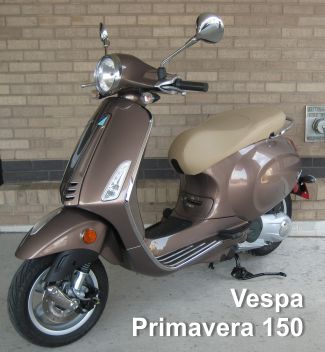
“La dolce vita” (Italian for “the sweet life” or perhaps “the good life”) was the marketing cry of Vespa scooters back in their heyday. By the later 1950s and 1960s, Vespa scooters had grown far beyond their original purpose of inexpensive basic transportation. Piaggio had been a manufacturer of military equipment during the Second World War and in the post-war years they developed and produced something that the population of Italy desperately needed – a reliable, basic way to get around. Talk about the right place at the right time with the right product, Vespa sales boomed in Italy and the rest of Europe and even expanded to North America. Vespa’s marketing message during those baby-boomer/flower-power years certainly pulled the focus from basic transport toward la dolce vita. I believe it was French novelist Alphonse Karr who coined the phrase “The more things change the more they stay the same.” Here we are, about 50 years beyond the 1960s, and a new Vespa scooter has reaffirmed that good basic transportation can still transcend into the sweet life.
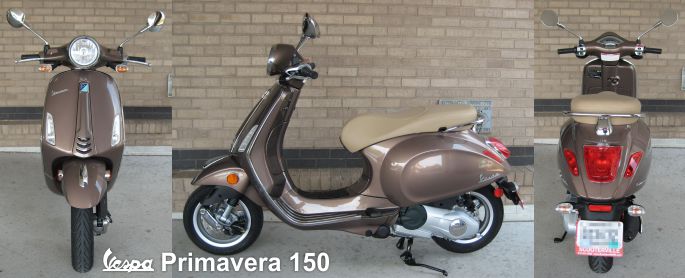
The 2015 Vespa Primavera can trace its lineage in a direct line back to those first, post-war Italian scooters. Since Vespa’s return to the USA 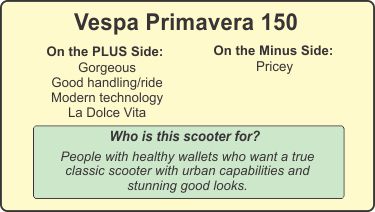 marketplace in 2000 (after a twenty year absence) we have seen the 150cc ET4, the 150cc LX and now the 150cc Primavera is here.
Bob Hedstrom of Scooterville generously made a brand new Primvera available to me. This was both generous and brave, as the last Vespa I reviewed was a GTS 300 from Scooterville that suffered from the “Don’t crash it” curse that Bob laid on it as I pulled out of Scooterville’s lot. (CLICK HERE for that review). This time, Bob uttered an equally prophetic “Have fun” as I left Scooterville.
Speedometer Reading/Speed/Fuel Economy
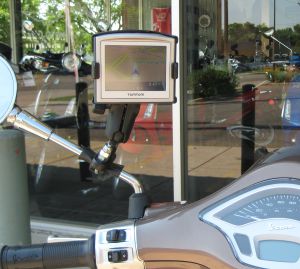 I mounted a GPS unit and headed for the gas station to top off the Primavera. Like many scooters, it is NOT easy to fill the petrol tank without a bit of backsplash. I was VERY careful and managed to get a full complement of fuel without needing to clean out the underseat storage area of spilled gasoline. Of course the underseat bucket is VERY easy to remove, so I suppose one could do that prior to filling the petrol tank. Unless you put a lot of miles on a scooter, this somewhat troublesome filling process won’t be much of an issue – more in a bit.
The majority of scooters we review have optimistic speedometers. That is to say their speedometers indicate faster than the actual speed. This was the case with the Vespa Primavera to the tune of 14% optimistic which is more than most. An indicated 30MPH was actually 26MPH and an indicated 50MPH was actually 43 MPH. The odometer was fairly accurate. I didn’t see a way to display tenths of a mile, so I ran around the pond near my house until the odometer ticked over and then started the GPS test. 11 miles on the GPS was 11 miles on the odometer. I could have been 11.5 or something, but the display was in whole numbers so….
The top speed I saw on a level road was 60 MPH. I make a habit of NOT reviewing the manufacturer’s specifications on a scooter I’m reviewing until I have completed my review process. Items like fuel economy and top speed are often overstated by manufacturers. In this case it would appear that Vespa is understating the top speed as they publish 59 MPH. I suspect it’s not just 1MPH difference as I was on a new scooter that was not yet broken in AND I’m forcing that poor little machine to haul a 220 lb load. I wouldn’t be surprised if a 150 lb rider on a broken in Primavera saw closer to 65MPH as the top end. The manufacturer’s specifications DO overstate fuel economy at 117MPG. I saw 90MPG in about 100 miles of mixed use. After break in and assuming mostly city speeds I THINK that 100MPG would be a possibility. Frankly, I consider the 90MPG to be quite good considering the performance capabilities of the Primavera. With a capacity of over two gallons, that means you won’t have to worry much about the sub-optimal filling situation.
Features
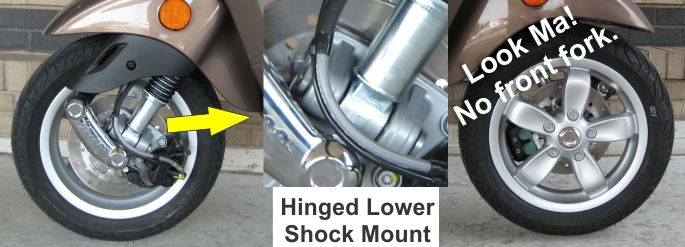
As mentioned earlier, Vespa scooters have been around since just after the Second World War. Several features of their design like the monocoque chassis and the swingarm front end have continued since the beginning of the Vespa line. Unlike every other scooter in current production, the Vespa has a sort of uni-body chassis of steel. Every other scooter has a metal sub-frame and attached plastic body panels. The Vespa steel body IS also the frame and as such offers a more rigid platform. The front suspension is a single sided trailing link. New for 2015 (like the GTS 300 we recently reviewed) the lower shock mount on the Primavera is now hinged. This allows the front suspension to maintain correct geometry with no lateral flexing. In combination with the monocoque steel chassis the enhanced front suspension contributes to a smooth and stable ride.
Can we call “looks” a feature? Based on the response this scooter got from people on the road, at parking lots, and my wife I think we have to. 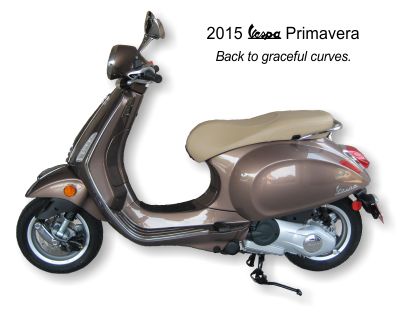 Though the rough outline of a Vespa scooter hasn’t changed all that much since 1947, there has certainly been an evolution of design. In the 1950s & 60s, Vespas were known for their graceful curves. When the P-series came out in 1977, some thought the shape far too “boxy”. Jump to 2000 in the USA (1996 in the rest of the world) and the bulbously curvy ET series hits the streets. 2005 saw the introduction of the still-curvy-but-less-bulbous LX series of scooters. Now 2015 brings us the Primavera (and Sprint) and we’re back to those gorgeous, graceful, smooth curves of 50+ years ago.
Vespa also stepped away from the round speedometer instrument cluster and reverted back to the “fan” or “clamshell” shape. The dash is clean, simple and easy to read at a glance….. in kilometers-per-hour. Yes, the Primavera is a “world” 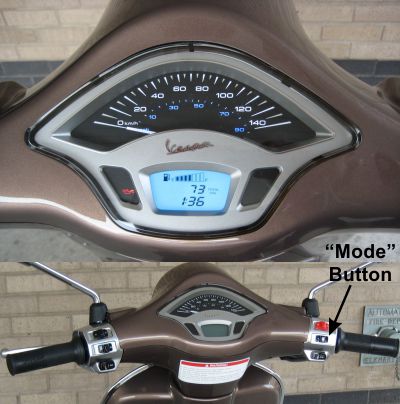 scooter and most of the world is metric in its measurement of speed. Miles are indicated down there in smaller numerals below the kilometers. Directly below the speedo is a multi-function display with pods of indicator lights on either side. The hand controls are standard with the exception of a “mode” button on the right-hand side for the aforementioned multi-function display. Yes, the odometer can be read in either kilometers or miles. Oh yes, I should mention that the turn signal switch works just like the majority of other good scooters on the market. That is to say that the previous Vespa “rocker” turn signal switch is gone in favor of a standard push-to-cancel style that is easier to operate than the old rocker.
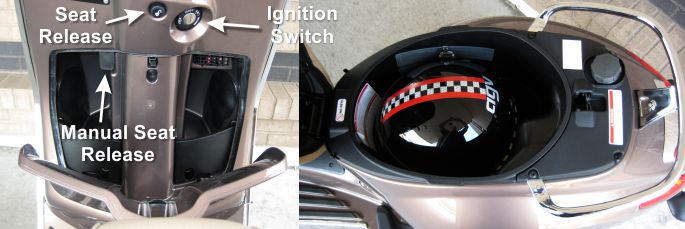
There are three positions on the ignition switch, the off position, the run position just clockwise and a “lock” position counter-clockwise. In the “lock” position the key can be removed, the front wheel is locked to the left and the seat switch is disabled. In addition to the electronic seat latch release to the left of the switch, there is a manual release inside the glove box. To open the glove box, one pushes in on the switch. The glove box has a couple of small compartments on either side of the steering shaft. The bucket under the seat is roomy and it did manage to swallow up my XXL 3/4 helmet…. just. There are myriad other storage and hauling options for the Primavera. In stock form, it is equipped with a chrome grab rail for passengers, but that can easily be swapped out for a luggage rack. With a rack mounted, a topcase, basket or milk crate will provide more room to haul your stuff. There is also an optional front folding rack available.
The Primavera continues Vespa’s tradition of excellent ergonomics. The seat, floorboards and hand controls are spaced and positioned to allow comfortable riding for a wide range of rider sizes. Most of the ergonomic components of the Primavera are very similar to the LX with 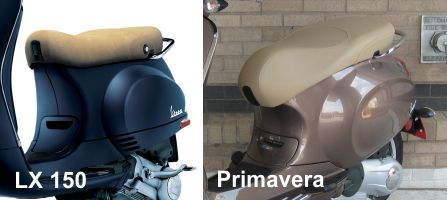 the exception of the seat. The LX series of scooters had a VERY comfortable seat that was roomy though it did rise up a bit more than some liked at the very front. The seat on the Primavera has been re-formed to get rid of the rise at the front and have softer edges on the sides. The result is a slightly lower seat height than the LX and it looks like it should be even more comfortable than the LX was. It isn’t. Don’t get me wrong, it’s a nice seat and it is certainly not UNcomfotable, but I like the old LX version better. Lighting is good, but I was hoping for more LED as seen on some scooters that cost less than the Vespa.
Riding Impressions
The Vespa Primavera started and ran flawlessly during my review. Just turn the key to the on position, wait for the fuel pump to charge, grab a brake lever, and press the starter button on the right-hand control and the scooter is ready to go. A smooth idle was just a minute or two 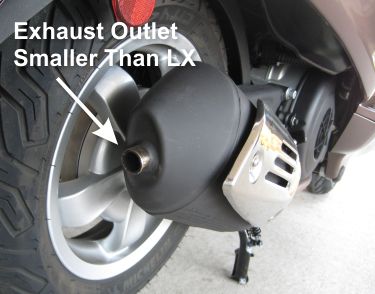 away after a cold start and immediate on warm starts. The fuel-injected, three-valve 155cc is mated to a CVT (Continuously Variable Transmission) that seems perfectly set up to take advantage of the about one horsepower increased output as opposed to the old LX-150. I have to say I was expecting a little more from the Primavera in the area of acceleration. On paper, it SHOULD be quicker than the LX but I don’t think it is. Acceleration from a stop is brisk and there are no flat spots up to about 50MPH when the forward surge slows until the top speed is reached. I also noticed that the exhaust note is different than the LX, it almost sounds like there’s a small exhaust leak. Looking at the Primavera side-by-side with an LX revealed that the exhaust outlet is smaller on the Primavera. I suspect that the exhaust system on the Primavera may be more restrictive than that of the LX which could account for the lack of additional performance. The Primavera has more than enough power for surface streets and has the top end to handle short highway jaunts of 55MPH to 60MPH, about the same as the LX did with maybe a touch more top end.
Handling on the Primavera is markedly improved from the LX. As mentioned at the beginning of “Features” the Primavera enjoys a new hinged lower shock mount on the front suspension. This goes a long way to curing the wandering feeling the LX was known for. There is still 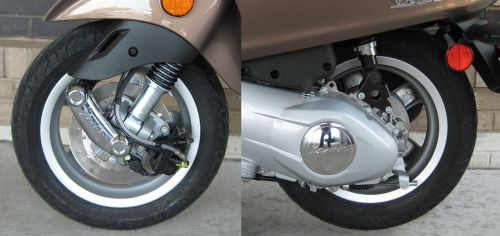 a touch of wallowing when making fast transitions, but overall the rider is much more controlled while still feeling smoother than most scooters of its class. Braking is adequate. The Primavera does not have the new anti-lock braking that the GTS AND the Sprint do. At the very beginning of the review I had a minor rear brake issue that was immediately handled by a minor adjustment. The front disc rear drum combination is easy to modulate and only a tiny bit of fade is noticeable after a lot of repeated hard stops. The Primavera is an easy scooter to ride briskly. The eleven inch tires, front and rear, contribute to quick response to steering inputs while being a bit more stable than the more common ten inchers found on other scooters.
My wife Beverly also rode the Primavera. Her regular “Italian” ride is a Vespa GTS 250 large frame scooter. She fell in love with the smaller size and lighter weight of the Primavera almost instantly. Of course before she ever mentioned the easier handling around town of the smaller scooter, she went on at great length about how wonderful the colour was and how incredibly cute the new design was. In fact her very first comment after a commute to the office was, “It’s just gorgeous, I want one.” No mention of positive attributes other than “gorgeous” was mentioned until I pressed her to define her impressions of the scooter. Oh yes, “looks” is a feature of this scooter.
Vespa Primavera vs. The Competition
For our comparison chart, I selected the Primavera’s stablemate from Piaggio, the Fly 150, and the Genuine Buddy 170i which has developed an almost cult-like following since the Buddy’s USA debut in 2006.
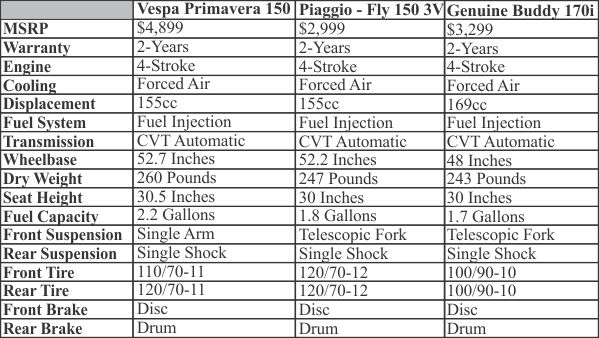 Both comparison scooters are less expensive than the Primavera. The Genuine Buddy is quicker, faster, has well-established industry leading quality, a great warranty, and TONS of available accessories. The Piaggio Fly 150 is currently my favourite machine in this class. The ergonomics of the Fly fit me better than any other 150 scooter. It offers excellent performance and handling, lots of native storage, good quality and economical operation. The Engineer in me keeps shouting that the Fly is a “better” machine than the Primavera (yes, there’s a little engineering voice in my head) as it does everything well and costs less.
HOWEVER, my wife has also ridden the Piaggio Fly and she DID NOT immediately say how much she wanted one. Here we enter into the realm of Vespa mystique. The combination of history, name recognition, design, metal body, excellent paintwork and so forth add up to something that is worth more to a lot of potential buyers. There is value in how the Primavera makes one feel when riding it.
Fit & Finish
Vespa scooters have been a mixed bag regarding fit and finish in the past. While the monocoque chassis/metal body is generally finished very well with gorgeous paint work, some of the components seemed lacking in quality and final assembly was sometimes less than perfect. Alignment of add-ons to the chassis and the fitting of fasteners could be just average at times and head-scratchingly poor at other times. In the past several years, I’ve noticed improvement in the Vespa line and the 2015 Primavera 150 shows marked gains in quality control. Everything fit well on the scooter I reviewed and I expect time will prove out the overall quality of this machine. The paint work on the chassis continues to be breathtaking. Earlier I mentioned the change from a rocker turn signal switch to a conventional slider. I’ll add here that the apparent quality of the component is higher.
Conclusions
Bob Hedstrom’s “Have fun” admonition at the commencement of this review couldn’t have been more prophetic. After all of the checking, inspecting, testing and verifying I had a LOT of fun riding the Primavera. The scooter kept impressing my little engineering voice with it’s improved quality and it’s a blast to ride. I don’t think I could beat down that tiny engineer enough to purchase a Primavera over a Piaggio Fly, but my wife could – in an instant.
David Harrington