
There aren’t all that many brands who have managed to make THEIR product name representative of an entire product line in the minds of the North American consumer (think Kleenex for facial tissue), but Piaggio’s Vespa is certainly one. Even the scooter-haters of the powered two-wheeled conveyance world (you know who you are) at least acknowledge the presence of “Vespa” and for many ordinary people “Vespa” is synonymous with “Scooter”.
Just after the Second World War, Enrico Piaggio (his father, Rinaldo Piaggio had founded the company) kept his family’s business alive by 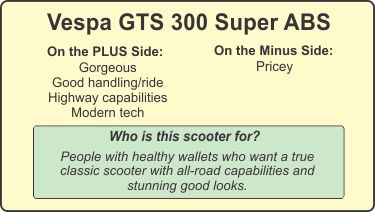 designing and producing viable, inexpensive transport products and the Vespa dynasty was born. In 1947 the monocoque chassis that completely hid all the “dirty bits” (drivetrain), the step-through position and the gorgeous design laid a foundation that Piaggio continues to build upon today. Until the introduction of the modern large-frame Vespa in the form of the Gran Turismo 200 in 2003, Vespa scooters were predominantly 150cc or less and were air-cooled. In 2006, we saw the introduction of the Vespa GTS 250 – large frame, liquid-cooled, AND fuel injected. As it happens, I have a GTS 250 in my garage so I am not without experience when it comes to modern Vespas. Vespa upped the game again for North America in 2009 with the GTS 300 (well…. 278cc) and now in 2015 we are getting Anti-Lock Braking Systems (ABS) along with an enhanced front suspension design.
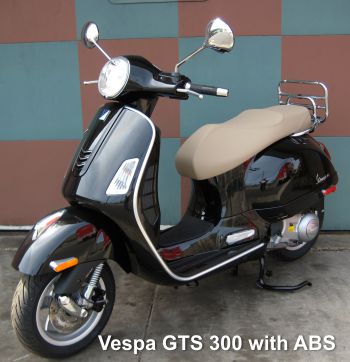
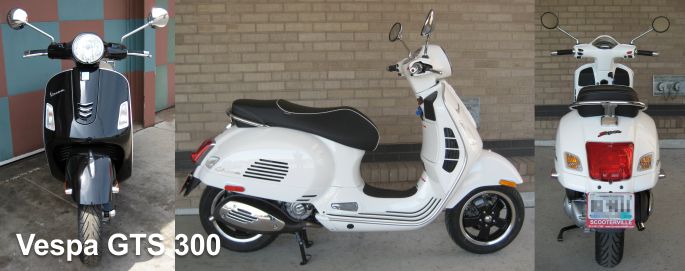
Bob Hedstrom of Scooterville generously made a brand spanking new white Vespa GTS 300 Super available to me. “Don’t crash it” he said as I pulled out of Scooterville’s lot on a sunny spring day. Those ESPECIALLY clever among you may have noticed that the lead picture is NOT of a white Vespa…. more in a bit.
Speedometer Reading/Speed/Fuel Economy
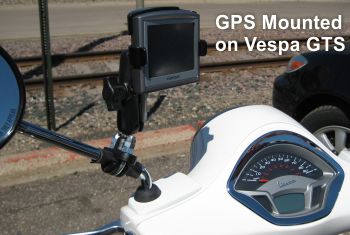 My first stop on the Vespa GTS 300 Super was to top off the fuel tank and attach my GPS. Like nearly every scooter we review, the Vespa speedometer was optimistic, though not that much. It indicates about 6% faster than actual speed. An indicated 30 MPH is really 28MPH and an indicated 60 MPH is in actuality more like 56MPH. The odometer was accurate with an actual trip of 11.0 miles indicating….. 11.0 miles. The top speed I saw on the GPS was 77MPH (indicated 82) though this was a new scooter and I didn’t expend a lot of effort to wring out the top end. Some break-in miles and a rider who is NOT a 220 pound curmudgeon may well yield a bit more terminal speed. Over a little less than 100 miles of varied riding I saw 72 MPG for fuel consumption. I consider that quite good especially for a new scooter in this size class.
Features
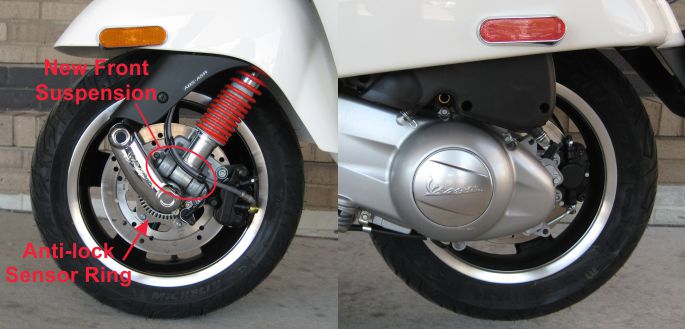
History and unique design elements – how’s that for features? The Vespa GTS 300 has them both in spades. The monocoque chassis and the swingarm front end date back to 1940s and the very beginning of the Vespa line. Unlike every other scooter in current production, the Vespa has a sort of uni-body chassis of steel. Every other scooter has a metal sub-frame and attached plastic body panels. The Vespa steel body IS also the frame and as such offers a more rigid platform. The front suspension is a single sided trailing link. New for the 2015 GTS 300, the lower shock mount is now hinged. This allows the front suspension to maintain correct geometry with no lateral flexing. In combination with the monocoque steel chassis the enhanced front suspension contributes to a smooth and stable ride. Also new is the Anti-Lock Brake System (ABS) with electronic stability control.
In a departure from our usual review format, there is no comparison chart showing the featured scooter and a couple of competing models. I simply couldn’t think of anything to put in as competitors. Nothing else has the Steel monocoque chassis or the configuration of the Vespa GTS 300. I thought about the Vespa’s stablemate from Piaggio, the BV350, but that’s a big-wheeled machine. For those of you who crave such things, here are the specifications of the Vespa GTS 300: The MSRP of the 2015 Vespa GTS Super 300 ABS is $6,699, warranty coverage is for two years and the engine is a 278cc single-cylinder, liquid-cooled, fuel-injected four-valve configuration that puts out 21 horses and offers 16.5 pounds-feet of torque. Transmission of power to the rear wheel is by means of an automatic CVT (Continuously Variable Transmission). Front suspension is Vespa’s unique single side swing arm with the rear handled by two shocks. 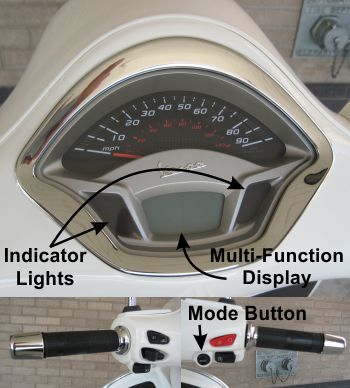 The front tire is a 120/70 twelve incher while the rear is a 130/70 twelve incher. Brakes are anti-lock discs front and rear. The wheelbase is 54 inches, the seat height is 31.5 inches, and the fuel tank holds 2.4 gallons. Vespa doesn’t publish a dry weight specification so I ran the scooter across a freight scale with fluids and got 356 pounds.
That $6,699 MSRP means the out-the-door price is likely to be $7,400 – $7,800 depending your locale’s tax situation. The GTS Super 300 is NOT a cheap ride. That being said, one gets more than just the “Vespa” name for that price. Lighting is bright and modern (including some LEDs). The dash is clean, simple and abandons the round speedometer in favour of the more true-to-vintage clamshell shape. Directly below the speedo is a multi-function display with pods of indicator lights on either side. Everything is easy to see and (shudder) logical. Why the shudder? If you’ve owned a Vespa with a simple digital clock in the dash that is powered by an odd-sized wristwatch battery that is very difficult to replace when it goes dead, you know. The hand controls are standard with the exception of a “mode” button on the right-hand side for the aforementioned multi-function display.
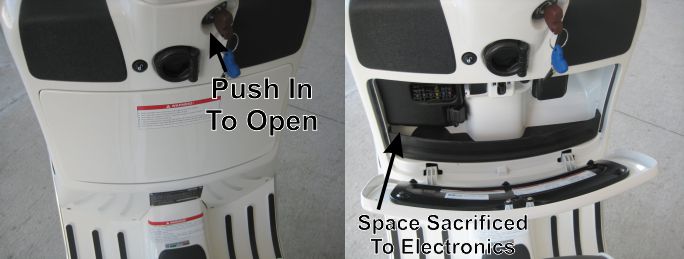
Storage includes an underseat bucket, glove box, luggage hook and myriad options including front and rear racks, topcases and the like. To open the glovebox, push inward on the ignition switch. Oh yes, about half the glovebox is sacrificed to electronics for the traction control.
Just to the left of the luggage hook is a button to unlatch the seat. With the key out, both the glove box and seat latches still operate. Hmmmm. OK, now I get it. There are three positions on the ignition switch, the off position, the run position just clockwise and a “lock” 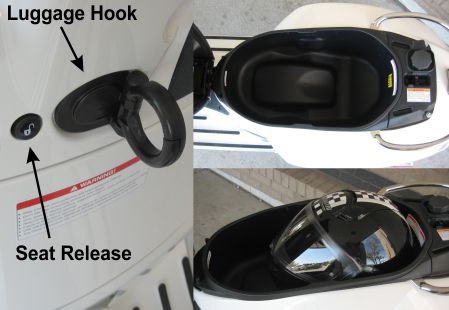 position anti-clockwise. (Sorry, “counter-clockwise”. I forgot what country I was in for just a moment.) In the “lock” position the key can be removed, the front wheel is locked to the left and the seat switch is disabled. The bucket under the seat is roomy though it wouldn’t accommodate my XXL full-face helmet. It did easily swallow up an armoured jacket, gloves, my lunch and my small camera bag. The Vespa GTS250 in my garage pulls regular commuter duty and, as such, it’s equipped with a topcase for extra luggage capacity. With the topcase, five bags of groceries is a breeze on the Vespa. I utilize cloth bags with handles and put two on the floorboards with the handles held by the luggage hook and my feet on either side of the bags. One more bag goes under the seat (non-perishables – it gets warm under there) and two in the topcase. Nothing to it.
Sitting on the Vespa GTS 300 Super before firing it up I am reminded how wonderful the GTS ergonomics are (remember, I’ve had one in the 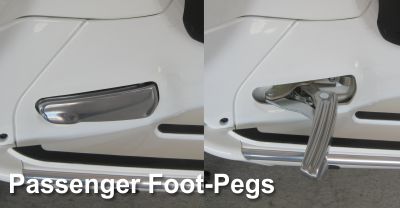 garage for some time). The stock seat is one of the most comfortable out there. Yes, I said “stock”, as in right out of the box. The seat, floorboards and hand controls seem to fit an unusually wide range of physical sizes equally well. The passenger accommodations are also nice on the GTS with amble space on the well-padded seat and fold out passenger foot pegs that allow a natural as opposed to bow-legged position for the pillion rider. It seems I’m frequently recommending that scooter purchasers include money in their budget for custom seat work. Sometimes it’s to accommodate a short or tall rider and sometimes it’s for long-ride comfort. The Vespa GTS is one of the few machines that is likely going to be just fine in the backside arena as is. The one potential ergonomic concern with the Vespa GTS is a combination of seat height and floorboard width. At 31.5 inches tall with a wide stance, shorter riders are going to have to lean the scooter a bit at stops. Luckly the Vespa has such a low center of gravity that it’s not much of a chore to hold up while at a mild angle. There are also aftermarket options if you want to reduce seat height a bit. My silver GTS 250 shown in the next image has one such seat installed and it takes a little over an inch off the height.
Riding Impressions
Turn the key to the on position, wait for the fuel pump to charge, grab a brake lever, and press the starter button on the right-hand control – the Vespa GTS 300 Super will fire right up. No choke, no “playing” with the throttle, just immediate, smooth running. Twist the right-hand grip and one is launched, briskly, into whatever riding adventure one has selected for the day.
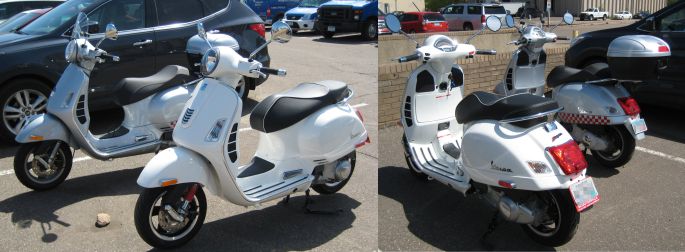
I had the unusual luck to be able to compare two iterations of the Vespa GTS side-by-side: my own (well, really, my wife’s) GTS 250 and the new GTS 300 Super. Both run and ride very smoothly. They share the Vespa monocoque chassis and the Quasar engine configuration of 4 valves, fuel injection and liquid cooling. So far as engine performance is concerned, I didn’t notice much difference from the “old” 250cc to the “new” 300 (278cc). They are both quite quick off the line and have more than adequate acceleration readily available up to about 55 MPH. To get from 55 MPH up to the top speed takes a bit longer. The GTS 300 is just a touch faster with maybe 3 or 4MPH more than the 250. On surface roads in the 45MPH to 55MPH range, the Vespa GTS is nothing short of wonderful. There’s enough power to keep up with, or stay ahead of, other traffic, and the frame size is just right feeling substantial enough for faster speeds while remaining nimble.
There are two marked differences between the GTS 250 and the GTS 300 Super: suspension and braking. While both offer a smooth ride and nimble handling, the older GTS 250 wallows a bit in the front end and is mushy in spirited curves. The new hinged lower front shock mount gives the GTS 300 Super a crisper and more confidence inspiring ride. The brakes on the GTS 250 (discs front and rear) are wonderful. They are strong and easy to modulate. The new anti-lock brakes and electronic traction control on the GTS 300 Super work but they require higher effort at the levers than the “plain” brakes on the GTS 250. I did run up to modest speeds on low traction surfaces to try out the ABS system and it works. Grab a fist full of levers and the scooter comes to a stop in a pretty straight line with little to no drama.
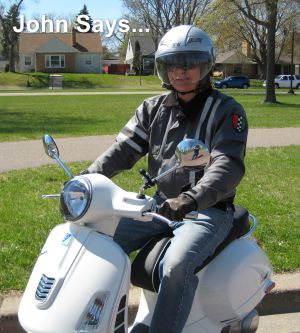 Searching for something other than another Vespa to compare the GTS 300 Super with, I corralled my friend John to help out and bring his Piaggio BV350 along. Oddly enough, John was the original owner of the Vespa GTS 250 I currently have so I think he was the perfect “volunteer” for this review.
The Piaggio BV 350 is my current King of the do-everything scooters. It’s a big-wheel (16 inch) scooter with ample power for freeway use, yet it remains light and nimble enough to be a joy around town. John appreciated the suspension improvements on the Vespa GTS 300 Super as compared to his old 250. After riding the new GTS 300 Super for a while, we took a break, swapped machines, and reviewed out experiences. John thought the Vespa GTS 300 was a wonderful machine and felt like the pinnacle of current scooter offerings, but that it was still very much a scooter. He views the BV350 as something like a motorcycle and scooter hybrid combining the best features of both into a different category of ride. I think he summed things up nicely and I realized that a comparison chart just wasn’t going to happen for this review. John was riding with me while I was in line in the right-turn lane at a stop. The young lady in front of me mistook “reverse” for “drive” and backed right into me. The rubber side stayed down and the front fender was the only casualty. The young lady had full insurance coverage and was quite apologetic, muttering the requisite “I didn’t see you” when she got out of her car. Why she was going backwards was never fully addressed.
Fit & Finish
Vespa scooters have been a mixed bag regarding fit and finish in the past. While the monocoque chassis/metal body is generally finished very well with gorgeous paint work, some of the components seemed lacking in quality and final assembly was sometimes less than perfect. Alignment of add-ons to the chassis and the fitting of fasteners could be just average at times and head-scratchingly poor at other times. In the past several years, I’ve noticed improvement in the Vespa line and the 2015 GTS 300 Super shows marked gains in quality control. Everything fit well on the scooter I reviewed and I expect time will prove out the overall quality of this machine. The paint work on the chassis continues to be breathtaking.
Conclusions
I like the Vespa GTS 300 Super, I like it a lot. Some would argue that a small-frame Vespa like the new Primavera or Sprint in 150cc is a better choice for riding around town. Not to take anything away from those machines, but I like having a little surplus power and general capability to hand even when cruising parkways at something resembling the legal speed limit (30MPH…. ish….). I still think a big-wheeled scooter is a more capable overall performer, but I wouldn’t be afraid to take a Vespa GTS out touring. I’d like to extend and extra big “Thank You” to Scooterville and Bob. He wasn’t thrilled about his admonition at the start being prophetic, but he forgave me after I did all the paperwork and dealt with the insurance adjuster.
Am I going to trade in my Vespa GTS 250 for one of the new 300s? Not likely. The only one that could tempt me is the GTV (fender-light) which is mechanically identical to the GTS 300, but has lots of extra goo-gahs AND the headlight is mounted on the front fender. Yeah, if you have to ask you wouldn’t understand. The GTV is, however, even pricier than the GTS and my wife isn’t particularly thrilled by it. I think we’ll stick with our GTS 250 for now. You, on the other hand, who DO NOT currently own a large-frame Vespa, need to review your finances and get to a dealer to check them out. The GTS is technologically advanced for a scooter, easy and fun to ride, comfortable, performs well and is gorgeous.
David Harrington