
August 2019
No, davvero, questa volta Lambretta e tornata, davvero.
Just thought I’d get that out of the way right up front for those of you who have been waiting for a modern “Lambretta” scooter to hit the North American market since, oh, the 1970s. I’ll touch on the Lambretta part of this scooter in a bit, but there are others (like Phil Waters* of POC Scooters and Peter Lundgren** of Corazzo) who have far more knowledge and insight than I do.
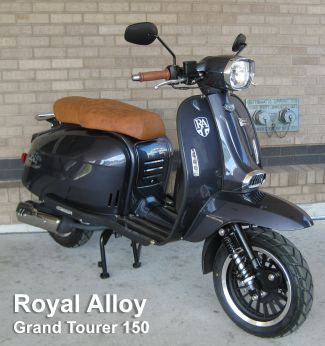
This review is going to involve a couple of Royal Alloy scooters. The first was a pre-production model that I rode a good bit last year and now a regular production version brought to us by Genuine Scooters (the same company who brought us the Stella and Buddy among others). 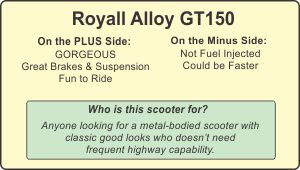 This review was facilitated by Scooterville in Minneapolis, MN, a wonderful dealership who has gone above and beyond in making these reviews possible. Structure will be touch different on this review as there were two scooters involved AND there is a bit of a story to address with this particular model.
For those who just want the short version (most of you I would guess), the Royal Alloy GT150 appears to be a sound machine and an good value. If you have been wondering what would replace the Stella in Genuine’s line-up, this is it. In my opinion, this is a BIG step up from the Stella Auto of yore and with a $3,499 MSRP represents the best-looking scooter in its price range.
Speedometer Reading/Speed/Fuel Economy
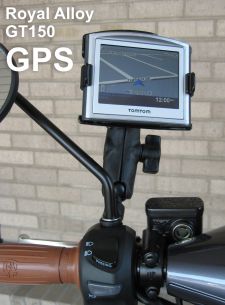 After some playing around with a mirror stem mount (didn’t work out) I added a washer and mounted the GPS under the mirror, topped off the fuel tank and left Scooterville for wide, wild world. As is pretty much normal, the Royal Alloy speedometer is optimistic by about 10%. The actual speed is slower than the indicated speed. When the speedometer indicates 30 MPH, the actual speed is 26 – 27 MPH. When the speedometer indicates 60 MPH, the actual speed is 53 – 54 MPH. The odometer was also optimistic indicating 27 miles for my 25 mile test run. The top speed I saw was 55 MPH (indicated 62). This was on a level road without much wind and a 190 pound load on the scooter. It was also a new scooter that was not yet broken in. I expect that after break in, on a level road, with a smaller rider, 60+ MPH may well be possible. Over the course of testing with mixed use (city streets, surface highways, etc.) I got 82 MPG. I consider this to be quite good and expect that, again, after break in with a lighter load 90+ MPG should be a realistic expectation.
Two Scooters & That Lambretta Look
I’m guessing that most of you bothering to read this know a bit about Lambretta. For that one person who accidently stumbled onto this site when their auto-correct changed their search for “Lamb Bread” into “Lambretta”, a quick recap may be in order. In the years following the second world war, Piaggio (Vespa) and Innocenti (Lambretta) manufactured scooters. There was a need for inexpensive personal transportation in post-war Europe and scooters fit the bill nicely. From the late 1940s, through the 1950s and 1960s both Vespa and Lambretta gained in popularity even gaining some small presence in not-very-scooter-friendly North America. In the very early 1970s Lambretta left Italy for Spain (Serveta) and India (SIL). Things muddled on for a few years until the Lambretta name fell down a deep, deep rabbit hole. The 2000s saw a growth in scooter popularity and the promise of a Lambretta resurection. Scomadi (a company formed by scooter designers/tuners) was initially involved with CMSI (TN’G Scooters) and a Vespa (gasp!) engined prototype made the round of various shows. The Lambretta name was applied to some Asian manufactured scooters. The rabbit hole was deep and filled with many tunnels. The years and litigation went by with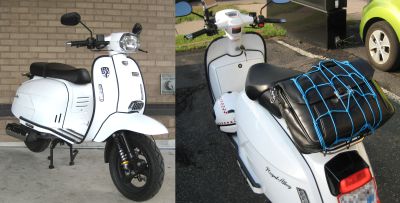 Scomadi continuing the take swings at getting a scooter out there. The went to Hanway in China to get their scooters built. Hanway built their scooters AND began selling DARN similar machines through MotoGB distribution as Royal Alloy. More legal action and Scomandi went to Thailand for scooter manufacture.
Yes, yes, it’s all much more confusing and convoluted than that, but I’m trying to keep this bit as short as I can. Last year, Genuine Scooters brought in a prototype Royal Alloy that found its way to Bob at Scooterville who (kindly) let me romp around on it a good bit. Other than some issues with the gauge cluster, it was a very nice machine. I strapped my man-purse to the rear rack, mounted my GPS and put quite a few miles on it. I was impressed and looked forward to seeing a production version.
There has been a lot of interest in a modern Lambretta-looking metal scooter in North America, especially since the demise of the Stella. To me, The Royal Alloy looks like a fatter series three Lambretta.
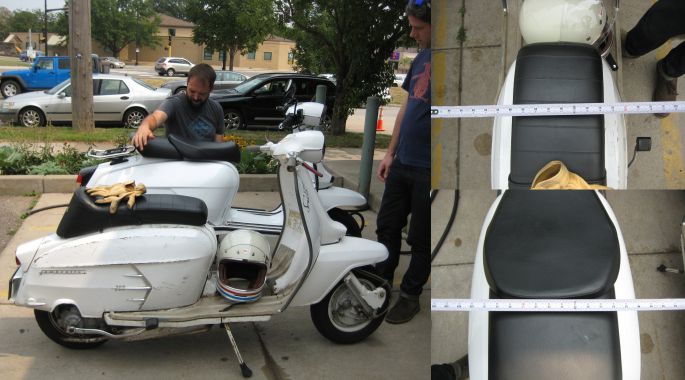
The Royal Alloy was about four inches wider than a Lammy that happened to show up at Scooterville. I would, again, refer you to those with far more knowledge than me should you wish to navigate that Lambretta rabbit hole further. Suffice to say that the Royal Allow as brought to us by Genuine Scooters looks like a Lammy, is metal-bodied, has modern technology and is priced about the same as a Stella was.
Features
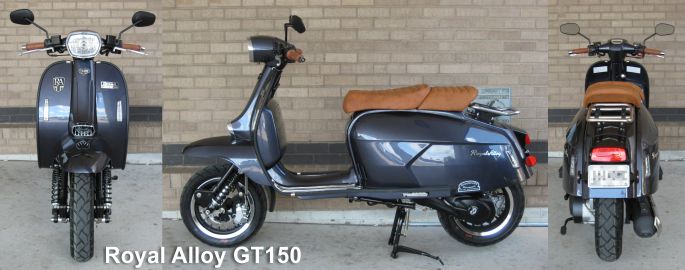
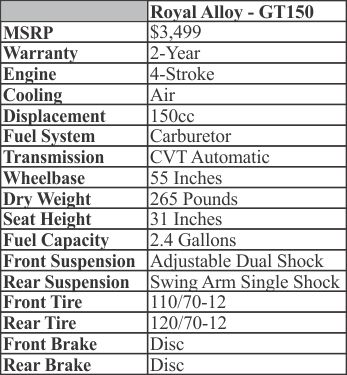 As we’re not doing a “Comparison” section in this review (no North American scooters to compare to the Royal Alloy) we’ll go over specifications here. The Royal Alloy GT150 has a metal body and is powered by an approximately 11 horsepower 150cc carbureted air-cooled SYM-designed (manufacturer remains uncertain)engine with an automatic CVT (Continuously Variable Transmission). The scooter rides on twelve inch wheels with a mono-shock swingarm rear suspension and what looks a lot like a Lambretta series three front end with dual ADJUSTABLE shocks and springs. Brakes are linked (pull a lever and both front and rear brakes engage) and are disc front and rear.
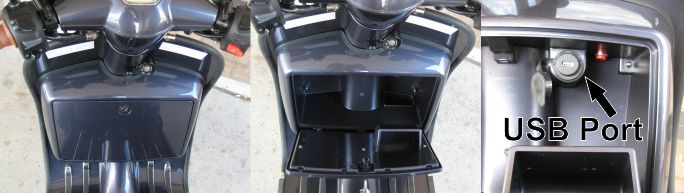
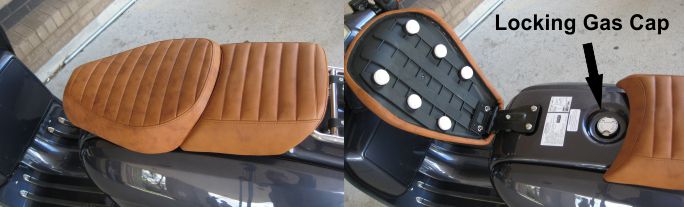
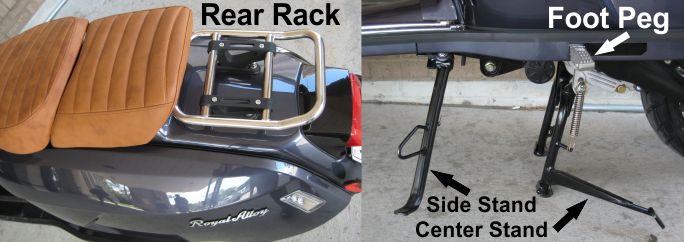
There is no under-seat storage on the Royal Alloy but there is a locking glove box and a small rear luggage rack. Though not available at the time of this writing, I have heard that accessories for the Royal Alloy will be in North America soon. Genuine Scooters has a history of offering very nice scooter-specific accessories. Just look at what is available for the Genuine Buddy, a LOT of cool stuff. Let’s hope it’s the same situation for the Royal Alloy. The glove box is roomy and does include a charging port. The rear portion of the seat is fixed, the front is hinged and gives access to the fuel tank.
The dash on the Royal Alloy is a single digital cluster that includes headlight and turn signal indicators, fuel gauge, volt meter, tachometer, odometer and speedometer. It is bright enough to see in all but the most direct sunlight. I know some people will think that a digital cluster ruins the vintage vibe of this scooter. Fine. Spend another $2,000+ and get a new Vespa 150 with a retro-styled analog speedometer. 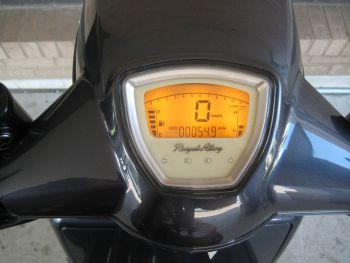
The mirrors are spaced far enough apart for decent rearward visibility. Controls are in the standard modern scooter configuration with the engine kill switch and electric starter on the right hand side. The headlight high and low beam switch, horn and turn signal switch are on the left hand side BUT the horn and turn signals are reversed from from the standard position. I hit the horn more often than I care to admit – thinking I was working the turn signals. Pretty sure I would adjust and stop frightening myself with the horn, but I’m old and it takes a long time for me to learn anything new. The Royal Alloy is equipped with both a side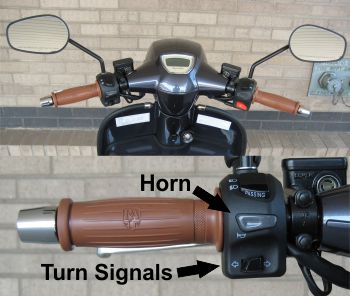 stand and a center stand. Passenger accommodations include flip-out foot pegs.
The ergonomics are quite good for the Royal Alloy though a bit different from many scooters of newer design. Much like its Lambretta “relatives” (Dare I say parents?) the reach for the hand controls is longer than someone who has only ridden oh, say, modern Vespas might be used to. One is not necessarily leaning forward very much, but one is likely to feel one’s torso is above the headset. I find this position quite comfortable. The seat is firm with a large enough passenger pillion to make two-up riding enjoyable. The riding position is high. The specifications on the Genuine website say 30.3 inches. I measured with the Royal Alloy off the center stand, held level and got 31 inches. Still not all that tall, but the width of the scooter means fairly spread out legs to reach the ground which contributes to the tall “feel” of this scooter. The center of gravity is low and a slight lean at stops to go flat-footed on one side is effortless without any “flop” or heavy weight felt by the rider.
The lighting is fine. I did a tiny bit of riding in the dark and the headlight illuminated what was in front of me quite well. If you want to see just how far scooter lighting has come, take a ride in the dark on a vintage Lambretta or Vespa. Best to duct tape an old Coleman lantern to the front of your scoot. The turn signal lights in the rear are integrated on the body panels. In the front there are integrated leg shield lights but the US version has added on turn signal lights by the hand controls. Those with sharp eyes will notice them missing from this particular scooter. I would imagine that they fell off, the dangling wires somehow slipped into the headset and down to the leg shields and worked their way into the appropriate sockets. Darnest thing (cough, cough).
Riding Impressions
I like fuel injected scooters. Really. That’s right, no carbureted scooters for me, thank you. Unless, of course, they start and run as well as the Royal Alloy did. Hot, cold, humid, whatever, the Royal Alloy fired right up and settled into a smooth idle quickly. Stay away from ethanol blends and you should be just fine with this set up. Acceleration off the line is good. Mid-range and roll-on acceleration was good. In fact the Royal Alloy is responsive to throttle inputs pretty much anyplace from zero to 45MPH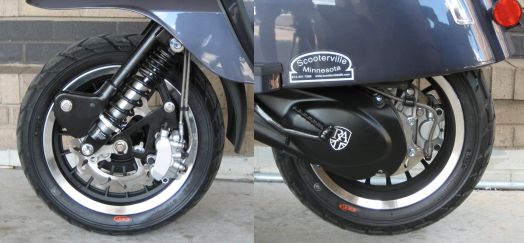 . Getting to higher speeds takes longer. Braking and handling are very good, outstanding even. I had my doubt about the front end but a few miles riding eliminated all my concerns. The twelve inch wheels (most would expect tens on a retro inspired scooter), longish wheelbase and excellent suspension, front and rear, add up to a VERY stable ride. The Royall Alloy also holds a line in a turn very well. My cloverleaf tests were drama-free. I imagine that pushed harder some metal bits (center stand) would likely drag before the suspension cried foul but I am an old man and no longer push things that far just to see if I can. The linked disc brake system was a joy. Strong stopping power, easy to modulate with just the right amount of feedback.
In addition to some city and parkway riding, I did two twenty-five plus mile runs on a mix of twisties and two-lane highways. Beyond having a big fat grin on my face the entire time I actually giggled once or twice. This thing is fun.
My wife road the Royal Alloy for several miles at 30MPH to 45MPH on some curvy streets and said she felt completely comfortable and found the scooter to be very stable. She DID hit the horn at least once when she thought she was cancelling a turn signal, but she did that less than me.
Fit & Finish
Manufacturing in mainland China can be good or bad. I have seen a LOT of Chinese scooters with abysmal fit and finish and some with good. The Royal Alloy is in the later category. The components utilized appear to be of good quality and assembled to high standards. The metal bodywork is well executed with very nice paint. At this time, The Royal Alloy GT150 is available in light blue, off white and the dark grey shown. Depending on the light, the dark grey can look like it has a touch of blue.
In my opinion, this bike is nothing short of gorgeous. It may well be the best looking new scooter currently offered. People looked it over every place I stopped and ALL of those comments were positive.
Conclusions
The Royal Alloy GT150 offers up a lot to like in a retro-themed scooter. I believe it offers a wonderful value alternative to a new Vespa. Right now, those are your only choices in a metal body scooter. Genuine Scooter Company had a winner in their two-stroke Stella. The four-stroke manual transmission Stella was pretty decent. The Stella automatic was…… let’s just skip that one. Now they are bringing us what looks to be another winner.
I would like to again thank Bob and his crew at Scooterville in Minneapolis Minnesota for providing the Royal Alloy used in this review.
David Harrington