
 Fly Scooters Closing Down
October, 2010
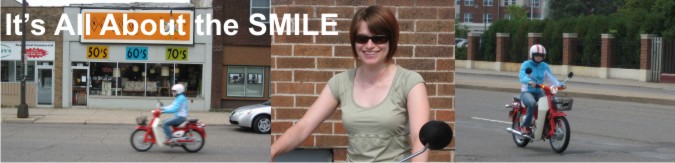
After Five years of operation, Fly Scooters in California is closing their doors. Leon and Daniel have seen their business shrink to the point that they can no longer sustain it. Unlike some of the distributors that have gone under, Fly had a good reputation for striving to bring good quality products for the price and strong support to their dealers. CLICK HERE or on the image for more information.
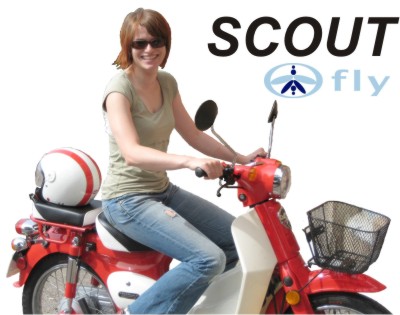
Is it a motorcycle or a scooter? What do you call a machine with two wheels and a motor that has a left-foot shifter, but no clutch lever? A semi-step-through design? The rider sits atop the fuel tank? I’m referring to the Scout, just introduced (and available at dealers) from Fly Scooters in California.
The Scout is based on the tried and true Honda Super-Cub design. First brought out in 1958 by the then 10-year-old Honda Motor Company, the Cub has gone on to become the best selling vehicle of all time with over 60 million of them sold all over the world. The combination of elegant design, robust mechanicals and flexible application have made the Cub a ubiquitous machine just about everyplace EXCEPT the USA. To get an idea of the extreme duty these machines are put to, I recommend the book “Bikes of Burden” by Hans Kemp. Really, you’ll be amazed. In the 1970s, Honda brought the Super-Cub to the USA market as the Honda Passport. By the early 1980s, the Passport stopped coming here. It’s been well over 20 years since we had this type of vehicle available to us.
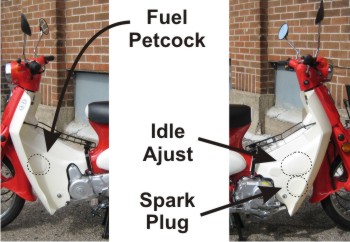
The Scout used for this review (VERY kindly provided by Fly) was pre-delivered by yours truly. The nice folks at Scooterville in Minneapolis received the carton and let me utilize some shop space to go over the Scout. Some assembly is required and a thorough inspection is critical to a good riding/ownership experience. At this point I’d like to mention how important a good dealer and strong dealer support is. It has been my experience that bikes from China need more care than bikes from Japan or Taiwan. Some Chinese brands have been making solid gains in quality in recent years (CFMoto comes to mind) and a knowledgeable dealer (like Marty at GoMoto) knows good product from bad and knows what to look for during pre-delivery inspection.
CLICK HERE to follow our ongoing Scout saga, from pre-delivery through long-term use.
 Wow, three paragraphs already, I really do tend to ramble on and on. Luckily for you, I realize just how tedious and boring I can be – so large parts of this review were written by Jordana Whyte. To make it easy for you to tell which bits were written by which person, I will mark Jordana’s stuff with the “Jordana Says…” graphic you see to the left. I’ll cover most of the technical stuff.
Speedometer Reading/Speed/Fuel Economy
 I use a GPS unit to perform some of the review tasks on scooters, including speedometer and odometer accuracy. The speedometer on the Scout is VERY accurate. Most scooters that I test read optimistically, that is to say they indicate a speed that is faster than the actual speed. The Scout is just about spot on. The odometer is also quite accurate. However, the speedometer display Miles Per Hour and the odometer displays Kilometers travelled. Not really a big deal, I would just like to see a little “km” shown next to the odometer display. Top speed with me riding (220 lbs.) was about 50 MPH. With Jordana riding (115 lbs.) over 50 MPH. Fuel economy is being tracked on our long-term review and has hit 105 Miles-Per-Gallon with Jordana riding the Scout. With me riding (bigger rider, riding harder and faster) I saw 93 MPG.
Features
Let’s look at the specifications of the Scout in comparison with the SYM Symba AND the machine they are both based on – the Honda Passport. Remember, the price on the Passport is from 1981.
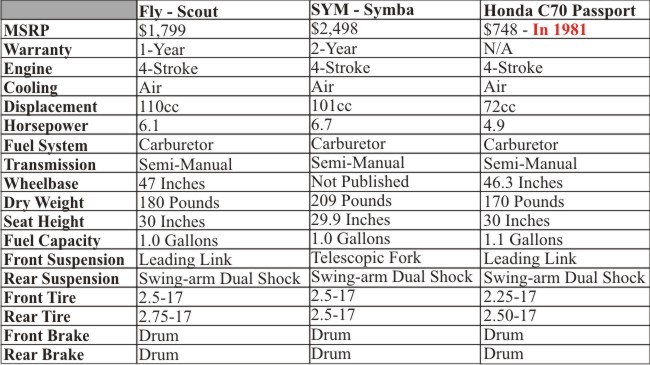
The Scout is powered by a SOHC, 2-valve, 4-stroke, air-cooled engine making a little over 6 horsepower. The displacement is about 110cc with a bore & stroke of 52.4 X 49.5 and a compression ratio of 9.0:1. Fuel and air are mixed and delivered by a carburetor. There is a semi-automatic (or semi-manual depending on one’s perspective) transmission and chain final drive.
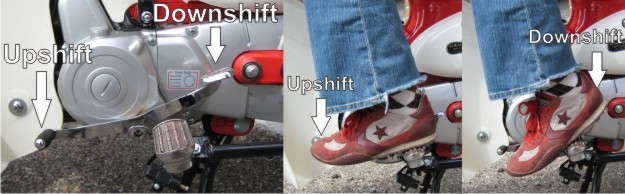
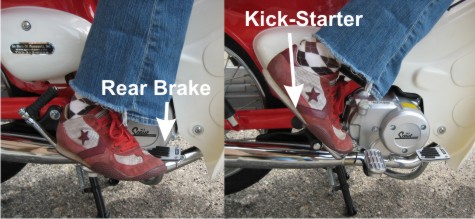
There’s a shifter on the left side, but no clutch lever on the left hand-control. To upshift one presses down with one’s toe. To downshift one presses down with one’s heel. In the old Hondas one had true rotary shifting. One could go from 4th right on to 1st. I believe the idea was to come up to a stop in high gear and then be just a single “click” away from taking off in 1st gear. This is not possible in the Scout and that’s probably a good thing as slamming from 4th to 1st unintentionally could be a problem. The Scout has both electric and kick starting.
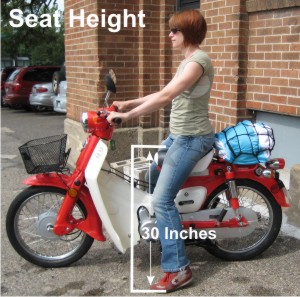
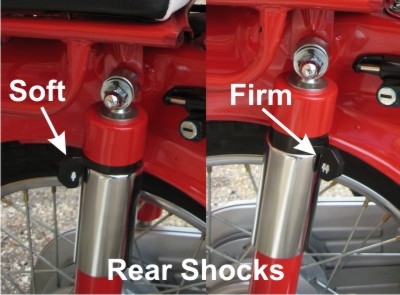
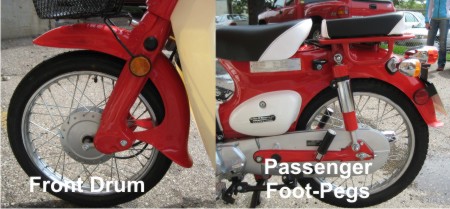 The wheels are 17 inchers with drum brakes both front and rear. The Scout rides on adjustable rear shocks and has a leading link front suspension. I like leading link myself, though I readily concede that the fork as used on the SYM Symba is better in most circumstances. The drum brakes are adequate as the Scout weighs a mere 180 lbs and can be brought to a halt without too much drama. Seat height is 30 inches and the small fuel tank under the seat holds barely one gallon.
 |
 |
|---|
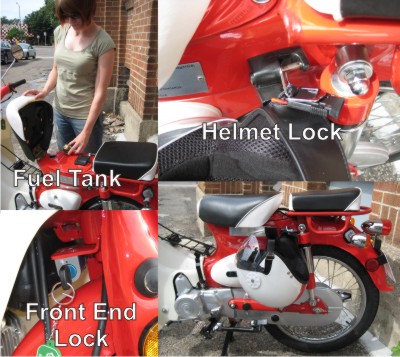
The Scout has several features that bear highlighting, though it is relatively light on the conveniences of its more modernized predecessors. There is no under seat storage on the Scout, so be prepared to take whatever you haul with you when you reach 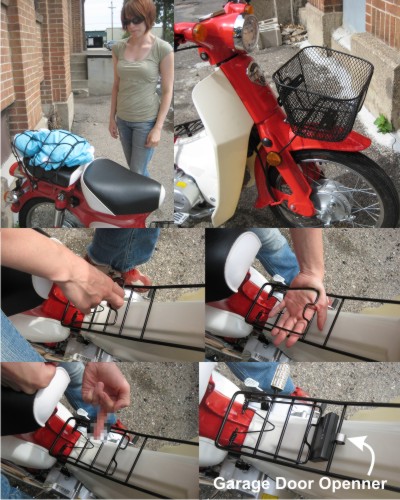 your destination. The basket on the front is handy, but somewhat shallow, so be sure that your cargo has some weight to it and doesn’t run the risk of popping out when you hit a bump. Metal bars that act as easy anchors for a bungee or cargo net surround the passenger seat. A jacket, box or bag is easily strapped there. There are two helmet locks on either side of the saddle. They are somewhat small with awkward access, so if you have bigger hands prepare to fumble a bit to lock down your brain bucket. A separate lock is located on the steering column for security against theft. My Buddy has this integrated into the ignition switch, so there’s no running the risk of taking off into unexpected tight circles. This is a minor inconvenience, though, as you can easily reach the lock while sitting on the seat. There is a third alleged cargo area between the calves on the leg-shield portion of the Scout. It has some sort of clamp contraption that apparently uses pressure to hold your precious belongings up against the scooter body. I can see only two practical uses for this spring loaded accident-waiting-to-happen. 1) clipping your garage door opener to it and 2) snapping the necks of any unsuspecting wildlife you’ve struck with the Scout in order to end their misery humanely.
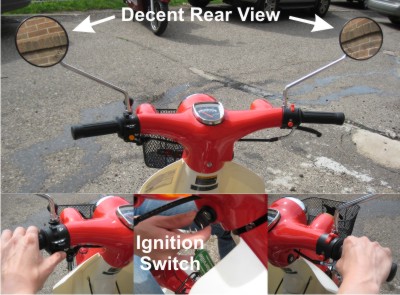 The “extras” pretty much end there. The rest is fairly basic, including your standard turn signals (with extra loud annoying beeps), high beams, engine kill switch and small display. The display indicates when you’re in neutral and inexplicably tracks your “mileage” in kilometers but your speed in miles. I’d say the one feature I’d really miss is the glove box like on my Buddy, where I can easily toss a few small objects. Truly, though, a key part of the Scout’s attractiveness is its pared-down, utilitarian nature. It doesn’t do fancy. It doesn’t do fussy. It doesn’t “do.” It just does.
 |
 |
|---|
Riding Impressions
My scooter experience comes from a brief affair with a 1986 50cc Honda Spree and my long-term relationship with a 2008 Genuine Buddy International 150cc. Both of these models are extraordinarily easy to drive: just put the key in, hit the start button and you’re off. That’s one of the features I was looking for when I was shopping for my scooter two years ago – ease of use. So when I was asked to review the Scout, I was dubious about learning to ride a shiftie. It seemed like too much effort.
I was drawn to it instantly. It has “retro” styling that really isn’t “styling” at all, as it is based on a design that has remained relatively unchanged, looks-wise, since it was first introduced in 1950. When the Scout showed up at my door, a passing mail carrier immediately stopped by to ask about it. When I pulled out of my garage for my first solo practice run, my neighbors were down the alley before I could shift out of neutral. The reaction is generally the same. What is it? It looks brand new! This is very different from my Buddy, which has touches of throwback flair, but is clearly a modern vehicle. The Scout is a new scooter in disguise.
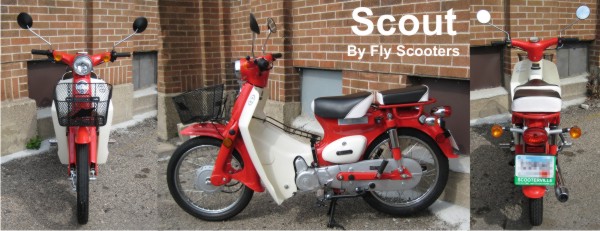
Aesthetically, it was love at first sight. I was extremely concerned about wrapping my brain around the actual operation of the scooter, which is, of course, integral to its usefulness as transportation. The Scout has a semi-automatic transmission, meaning that there isn’t a clutch lever like on a standard motorcycle or shiftie scooter. This means there is one less thing to think about. For me, this is a good thing. While I have no trouble driving a manual transmission car, there was something intimidating about coordinating a throttle, a front brake lever, a back brake pedal, an up-shift pedal and a down-shift pedal. I took the Motorcycle Safety Course on my Buddy and blissfully tuned out any and all instruction regarding shifting, clutch levers and warnings about popping wheelies.
For those of you that remember what it’s like to learn a shiftie, you know what’s coming next: it was pretty easy. With a few practice sessions in an empty parking lot, and a patient teacher answering my stupid questions and grimacing through my jerky starts and stops, I got the hang of it rather quickly. Like most things, it just took getting used to. With time, I’m certain I’ll be quite confident on the Scout. After only a relatively brief time with it, I’ve already stopped talking to myself out loud as I go through the operations (“Third! Fourth! Remember both brakes! Downshifting to third!”). The semi-automatic transmission makes it pretty easy once you have the hand-eye coordination down. It has four gears that you move through by a simple push of the toe to move up, and a simple push of the heel to go down. The clutch engages automatically as you push down on the shifter pedals. Mercifully, you cannot shift from fourth back into first, or I would not be around to write this review. Once you are in fourth, nothing happens if you let off the throttle and try to shift up again.
First gear is pretty well useless. You will have to shift out of it more or less immediately, which makes me a little nervous when making a left hand turn into traffic from a stop, for example. One thing my 150cc Buddy does well is accelerate like a champ, which I consider a safety feature if any kind of evasive maneuver is necessary. I found it was often easier to start from second, even from a stop, which the scooter is happy to accommodate without complaint. Second gear will slip by pretty quickly as well. In fact, you’re in the top gear by about 22-25mph, which in comparison to a manual transmission car comes pretty early, given that top speed is somewhere in the 50s. That’s coming from a five-speed car background, though. The only four-speed vehicle I’ve driven was a former roommate’s 1982 Tercel hatchback, which I’m pretty sure the 110cc Scout could overtake in a road race. Somewhere around 30mph it really feels like the Scout is begging for a fifth gear, but it smooths out after that. This is where I learned that nothing happens if you’re already in fourth and try to shift up. I tried several times because it felt like there should be somewhere else to go, but it passes quickly. The ride at upper speeds is relatively smooth; there are no shakes or shimmies or unsettling vibrations to speak of. The smoothness of the ride at lower speeds will largely depend on your ability to shift and downshift gracefully. So in my case, not so much, but with marked improvement after each ride. Be prepared to feel at least every mid-sized bump on the road. The Scout doesn’t have the most forgiving suspension. I also noticed that my wrists were tingly/sore after longer rides, presumably from my initial white-knuckle death grip on the handlebars, but also at least somewhat from the not-so-dampened general riding vibrations. A true long haul could potentially be bone rattling.
The feel of riding a semi-step-through is different than the standard flat bottom scooter. And frankly, it’s more fun. I love having nothing between the road and my feet but the pegs. It was like riding one of those roller coasters where your legs dangle. I think that contributed to the sensation that I was going much, much faster that the speedometer indicated. Thirty feels like sixty, and fifty feels like a million.
Alas, it can’t all be gold. My chief complaint about the Scout is its finicky starting process. The Buddy couldn’t be easier. Twist. Push. Go. The Scout needs a little finessing. On a “cold” start, either temperature-wise or after some time sitting in the garage, the Scout is not terribly eager to get going. To be fair, this is the first scooter I’ve had that has a choke, which I would define for you if I had any idea what it actually does, other than the general notion that it helps get the engine running smoothly on a cold start. There is a sweet spot with the choke that I have yet to find. I am infinitely patient with my fellow human beings, probably to a fault, but nothing elicits toe-curling profanity from me like an uncooperative inanimate object. The honeymoon with the Scout was nearly over when I ran into this little gem of a problem. However, like most newlyweds, once we got going, I forgot all about it…until the next time. I’m fairly confident that I can learn the finer points of the choke with more practice. I certainly hope so. Nothing is more disheartening than that sputtering engine death when you’re ready to ride. Apparently this is an authentic holdover trait from the Super Cub, but it’s one point upon which I wish they’d actually try to improve.
* NOTE FROM DAVE* I did not have the same starting issues as Jordana, but I am VERY used to manual choke controls.
Fit and Finish
The Scout is made in China and the quality of the components and build quality is just not as good as bikes from Japan and Taiwan. That being said, some Chinese manufacturers have made big gains in quality in recent years (CF Moto comes to mind). The Scout has better paintwork than I expected, and the mechanical components (brakes, suspension, etc.) though not as well finished as their Japanese and Taiwanese counterparts, function well. Time will be the telling element so far as quality is concerned on the Scout.
CLICK HERE to follow our ongoing Scout saga, from pre-delivery through long-term use.
Scout vs. Symba
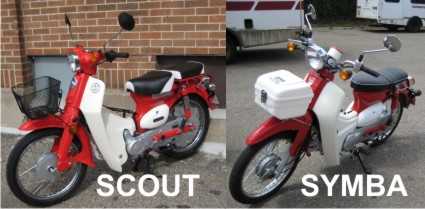 In 2009, SYM (through Carter Brothers, their US distributor) brought the Symba to the USA. Also based on the Honda Cub design, the Symba added a real front fork and SYM build quality. The bike has been well-received, though the MSRP is nearly $2,500. The out-the-door price on a Symba can be $3,000. Personally, I think it’s probably worth it given the quality of the components and manufacture. Still, for a small displacement (less than 110cc) bike that’s a high price point for a lot of potential buyers. The owners of Fly have been working on a Cub-style design bike for a couple of years now. Marty at GoMoto is the local Fly dealer and he has ridden and given feedback on two of the three prototypes from Fly. In my opinion, dealer involvement at the early stages is a good thing.
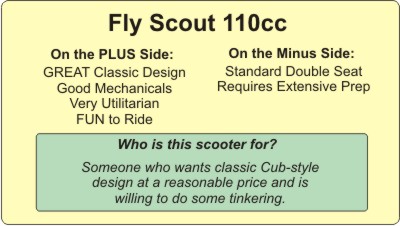
The Scout is manufactured in China and has an MSRP of $1,799, though I have talked to dealers who are getting them out-the-door to customers for about $2,000, so they are either lowering the price or not charging for set-up, freight and the like. In street price comparisons, I think it’s safe to say there is close to a $1,000 price difference between the Scout and the Symba. In the small-displacement bike market, this is a big number. Which one is “better”? The Symba has component and build quality that is a step above the Scout. Which one is a “better value”? That’s up to you to decide.
Conclusions
I’ve been trying to put my finger on exactly what it is that makes the Scout feel so special, despite it being more complicated, less convenient and less cushy than my beloved Buddy. There is some magic combination of practicality, classic good looks and quirkiness; something about the Scout exudes confidence and capability, like it’s just going to go out and get the job done, and have some fun while it’s at it. The Buddy is just that: a pal, a passive friend that gives you a ride. The Scout is a sidekick. You don’t ride it. You drive it. You’re in it together. Let me put it this way: if I were to pull some kind of heist, or be involved in a caper of some sort, my getaway vehicle of choice would be the Scout and not the Buddy. I like that driving the Scout brings out a sense of collusion and adventure, and apparently 60 million people agree with me.
The Scout is plucky. And I like pluck.